
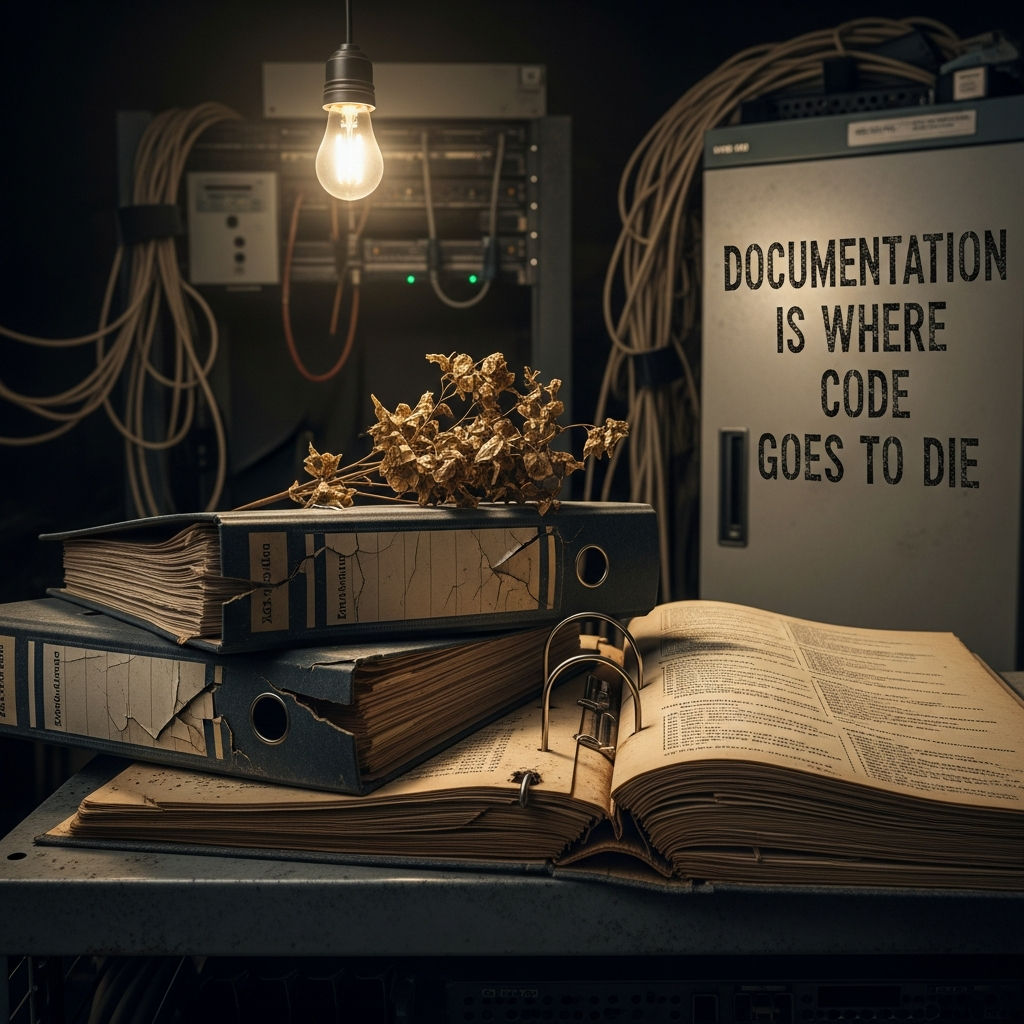
Documentation is Where Code Goes to Die: The Paradox of Modern Software Development
In the fast-paced world of software engineering, there is a cynical adage often whispered in the hallways of tech giants and startups alike: “Documentation is where code goes to die.” It is a sentiment born out of frustration, representing the millions of hours spent writing Wiki pages that no one reads, README files that lead to broken builds, and API references that are three versions behind the current release.
For many developers, documentation feels like a graveyard. It is the place where momentum halts, where the creative flow of coding meets the bureaucratic wall of prose. However, the tragedy isn’t that we write documentation; the tragedy is that we often write it so poorly—or at the wrong time—that it becomes a tombstone for the logic it was meant to illuminate. To build sustainable software, we must understand why documentation decays and how to transform it from a static archive into a living part of the codebase.
The Anatomy of Documentation Decay
Why does documentation earn such a morbid reputation? The primary reason is bit rot. While code is subject to compilers, linters, and automated tests that scream when something is wrong, documentation is silent. When a function signature changes in the code, the documentation describing it doesn’t automatically update. It sits there, increasingly inaccurate, until a new developer tries to follow it and fails.
The Disconnect Between Writing and Executing
Documentation often dies because it is detached from the developer’s primary workflow. If a developer has to leave their Integrated Development Environment (IDE) to open a separate web-based tool like Confluence or Notion to update a paragraph, they are significantly less likely to do it. This friction creates a gap where the code evolves at the speed of thought, while the documentation remains frozen in the moment the feature was first conceived.
The “Write-Only” Problem
We have all encountered “write-only” documentation. This happens when a management mandate requires every pull request to include updated docs. Developers, eager to get back to coding, produce the bare minimum. The result is a flood of low-value information that obscures the important details. When documentation is treated as a checkbox rather than a communication tool, it becomes noise—and in the world of software, noise is where clarity goes to die.
The High Cost of a Documentation Graveyard
When documentation becomes a graveyard, the costs are not just emotional; they are financial and operational. Stale information acts as a tax on every developer who joins the project or attempts to maintain a legacy system.
- Increased Onboarding Time: New hires spend days or weeks navigating “broken” instructions, leading to frustration and a loss of confidence in the team’s engineering standards.
- The “Bus Factor” Risk: If the only accurate “documentation” exists in a senior developer’s head because the written docs are dead, the project is one resignation away from a total knowledge blackout.
- Security and Compliance Gaps: Inregulated industries, dead documentation can lead to audits failing or security vulnerabilities remaining unpatched because the “official” procedure no longer reflects reality.
- Shadow Maintenance: Developers spend more time “archaeologizing” the code—reading every line to figure out what it does—than they do adding value, simply because they cannot trust the written word.
Resurrecting the Dead: The Shift to “Documentation as Code”
To prevent documentation from becoming a graveyard, we must treat it with the same rigor we apply to our source code. This philosophy is known as Documentation as Code (DaC). By integrating documentation into the development lifecycle, we ensure it lives, breathes, and evolves alongside the software.
Markdown and Version Control
The first step in resurrection is moving documentation out of siloed wikis and into the repository. Using Markdown files (like README.md or architecture docs) stored directly in Git ensures that any change to the code can be accompanied by a change to the docs in the same commit. This makes documentation review a standard part of the Peer Review process.
Automated Testing for Documentation
If documentation is where code goes to die, then automation is the spark of life. Modern tools allow developers to test their documentation. For example, tools can scan README files to ensure that the code snippets provided actually compile and run. Link checkers can ensure that no external references have gone 404. When the “build fails” because the documentation is wrong, documentation suddenly becomes a first-class citizen.
Living Architecture Decision Records (ADRs)
One of the most effective ways to keep documentation alive is through ADRs. Instead of writing massive, monolithic design documents that become obsolete instantly, teams record short, dated snapshots of why a decision was made. These records provide context for future developers, explaining the constraints and trade-offs of the time, rather than just the “how-to” of the current state.
Strategies for Sustainable Documentation
Creating a culture where documentation thrives requires a strategic approach. It is not about writing more; it is about writing smarter. Here are several strategies to keep your knowledge base from becoming a graveyard:
- The “Just-in-Time” Approach: Don’t document every possible edge case before a line of code is written. Document as you discover the nuances. Write for the person who will be maintaining your code six months from now—which will likely be you.
- Curate, Don’t Just Collect: Periodically delete old documentation. A lean, accurate set of documents is infinitely more valuable than a vast, sprawling library of outdated information.
- Self-Documenting Code: The best way to keep documentation from dying is to make it unnecessary. Clean code, meaningful variable names, and intuitive API designs reduce the burden on written text. Documentation should explain the “Why,” while the code explains the “How.”
- Embed Docs in the UI: For user-facing features, tooltips and “empty state” guides are much more effective than a 50-page PDF manual. Put the information where the user (or developer) is already looking.
The Role of AI in Documentation Maintenance
We are entering a new era where Large Language Models (LLMs) are changing the relationship between code and documentation. AI can now assist in “resurrecting” dead docs by scanning codebases and identifying discrepancies between what the code does and what the README says. AI-driven tools can automatically generate boilerplate documentation, summarize complex pull requests, and even suggest updates to outdated Wiki pages.
However, AI is not a silver bullet. While it can handle the “noise,” the “signal”—the strategic intent and the high-level architecture—still requires human intervention. AI can keep the graveyard tidy, but it cannot prevent the death of knowledge if the developers themselves aren’t committed to clarity.
Conclusion: From Graveyard to Garden
Documentation is only where code goes to die if we treat it as an afterthought. If we view documentation as a static artifact—a monument to work completed—it will inevitably crumble. But if we view it as a garden, something that requires regular pruning, watering, and care, it becomes an essential asset that grows in value over time.
The goal of every engineering team should be to move away from the “graveyard” mentality. By adopting Documentation as Code, utilizing automation, and fostering a culture that values clear communication as much as clean logic, we can ensure that our documentation doesn’t mark the end of a project’s life, but rather provides the map for its continued evolution. In the end, well-maintained documentation doesn’t just describe the code; it preserves the wisdom of the engineers who wrote it.