
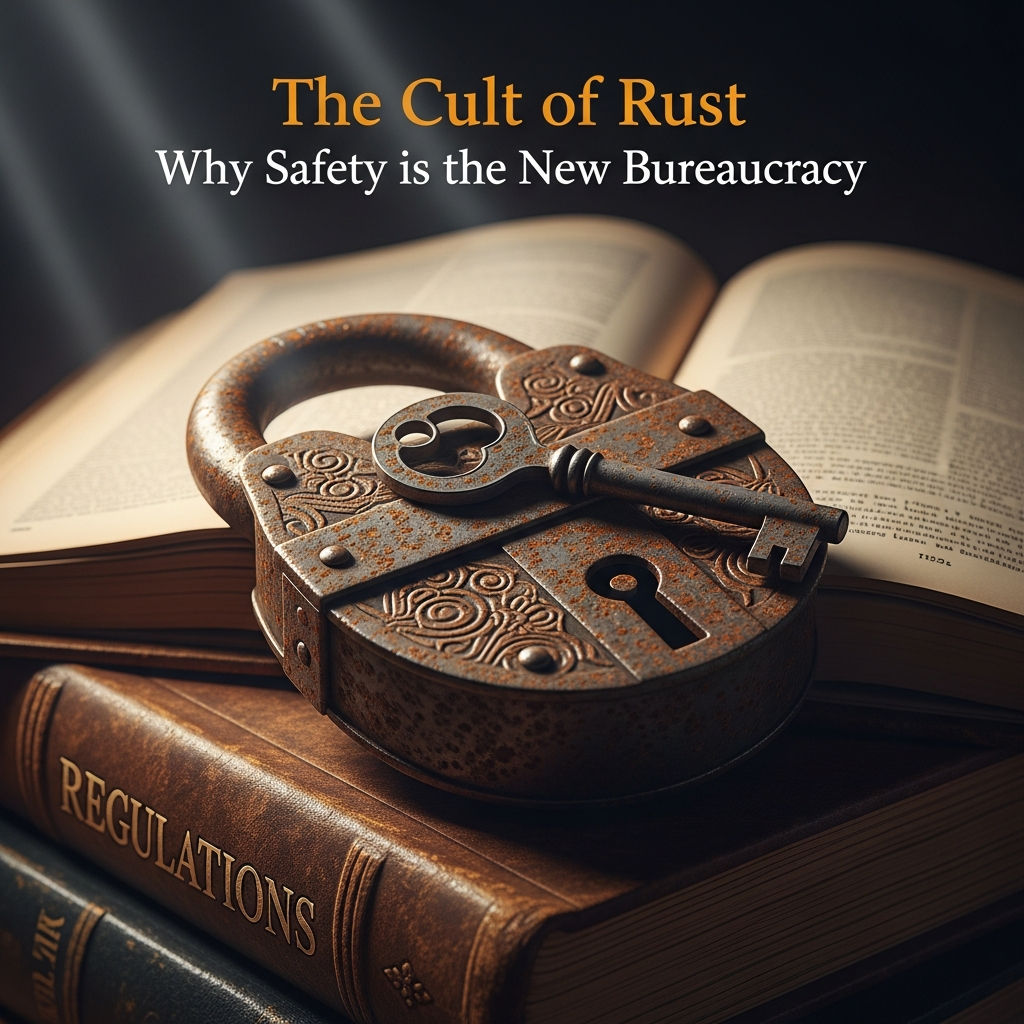
The Cult of Rust: Why Safety is the New Bureaucracy
In the landscape of modern software development, few languages have inspired as much fervor, devotion, and—dare we say—fanaticism as Rust. Consistently topping the charts as Stack Overflow’s “most loved” language, Rust has moved from a niche Mozilla project to the backbone of infrastructure at Amazon, Google, and Microsoft. However, beneath the surface of its memory-safe promises lies a growing debate. Is the rigorous enforcement of safety actually a form of digital bureaucracy? Has the “Cult of Rust” traded developer velocity for a series of complex permits issued by a relentless compiler?
For decades, systems programming was a wild west of C and C++. It was powerful, fast, and incredibly dangerous. One misplaced pointer could crash a spacecraft or expose the data of millions. Rust arrived as the sheriff, promising a world where “segfaults” are a relic of the past. But as any developer who has fought the borrow checker at 2:00 AM knows, that security comes with a heavy administrative cost.
The Rise of the Rustacean: Community or Cult?
To understand the “Cult of Rust,” one must first look at its community, affectionately known as “Rustaceans.” Unlike the pragmatic, often weary communities surrounding Java or C++, Rustaceans possess an evangelical zeal. This is driven by a shared trauma: the collective experience of debugging memory leaks and race conditions in older languages.
The “Rewrite It In Rust” (RIIR) movement has become a meme within the industry, but it stems from a sincere belief that any code not written in Rust is inherently a ticking time bomb. This mindset creates a binary world: you are either writing “Safe” code, or you are part of the problem. This moralization of syntax is what gives the community its “cult-like” reputation. When safety becomes a dogma rather than a tool, the language stops being a utility and starts becoming a philosophy.
The Compiler as the Ultimate Bureaucrat
In traditional languages, the compiler is a translator. In Rust, the compiler is a high-ranking government official in charge of the Department of Memory Allocation. It doesn’t just check if your code is syntactically correct; it audits your logic, your variable lifespans, and your data ownership patterns.
This is where the concept of “Safety as Bureaucracy” takes root. In a bureaucratic system, you cannot proceed with a project until every form is signed, every stamp is applied, and every regulation is met. Rust’s Borrow Checker functions exactly like this. It enforces a strict set of rules:
- Each value in Rust has a variable that’s its owner.
- There can only be one owner at a time.
- When the owner goes out of scope, the value is dropped.
- You can have many immutable references OR exactly one mutable reference, but never both.
While these rules prevent data races and memory corruption, they often feel like “red tape” when trying to implement common architectural patterns, such as doubly-linked lists or complex graph structures. What takes five minutes in Python or C might take five hours in Rust as you negotiate with the compiler for the “permit” to move a variable.
The Friction of Prototyping
One of the primary complaints against the Rust bureaucracy is the death of “exploratory programming.” In the early stages of a project, developers often want to “move fast and break things.” They need to iterate on a design, change data structures on the fly, and test hypotheses. Rust makes this incredibly difficult. Because the language requires you to solve every memory management detail upfront, the friction of prototyping is significantly higher.
In this sense, Rust is the “waterfall method” of programming languages. It demands total clarity and architectural perfection before the first binary is successfully compiled. For mission-critical systems, this is a blessing. For a startup trying to find product-market fit, it can be a bureaucratic nightmare that stifles innovation.
The Cost of “Zero-Cost” Abstractions
Rust prides itself on “zero-cost abstractions,” meaning that the safety features don’t incur a runtime performance penalty. However, this ignores the human cost. The “cost” hasn’t disappeared; it has been shifted from the CPU to the developer’s brain.

The cognitive load required to manage lifetimes and ownership is immense. Developers must constantly keep a mental model of the stack and heap, tracking exactly how long every piece of data lives. In a bureaucratic state, the citizens spend a significant portion of their energy simply complying with the state’s requirements. Similarly, Rust developers spend a significant portion of their “coding time” satisfying the compiler rather than solving the actual business problem.
Complexity and the “Expert Only” Barrier
As the language evolves, it becomes increasingly complex. Concepts like Pin, Unsafe, Arc, Mutex, and complex trait bounds create a high barrier to entry. We are seeing a divergence in the talent pool: the “Rust Elite” who can navigate the bureaucracy, and everyone else who is locked out. If the goal of a programming language is to empower creators, a language that requires a PhD-level understanding of memory geometry might be over-correcting for safety.
Is the Bureaucracy Justified?
Despite the “cult” accusations and the administrative overhead, the Bureaucracy of Rust exists for a reason. Statistics from Microsoft and Google suggest that roughly 70% of all security vulnerabilities are related to memory safety. By enforcing strict rules at compile time, Rust effectively eliminates an entire class of catastrophic failures.
In high-stakes environments, bureaucracy is often a necessary evil. We want the engineers building airplane flight controllers, medical devices, and global financial ledgers to be “bureaucratic.” We want them to have their work audited by a relentless, unfeeling compiler that refuses to look the other way.
The Middle Ground: When to Avoid the Cult
The danger lies in the “One Size Fits All” mentality. Not every application needs the level of rigor that Rust demands. If you are building a CRUD web application, a marketing landing page, or a data processing script, the Rust bureaucracy may actually be a detriment. In these cases, languages like Go, TypeScript, or Python offer a “good enough” level of safety with significantly less red tape.
- Choose Rust if: You are building a browser engine, an operating system, a high-frequency trading platform, or a shared library where performance and safety are non-negotiable.
- Avoid Rust if: You need to iterate rapidly, your team is composed of junior developers, or the “cost of failure” for your software is low.
Conclusion: The Future of Safety
Rust is not just a programming language; it is a reaction to thirty years of unstable software. It represents a shift in the industry’s values—from “developer comfort” to “systemic integrity.” While the Cult of Rust can be overbearing and its compiler can feel like a bureaucratic gatekeeper, it has set a new standard for what we should expect from our tools.
As we move forward, the challenge for the Rust community will be to reduce the “administrative burden.” Future versions of the language and better tooling must aim to make the “Safe” path not just the right path, but the easiest path. Until then, developers must decide for themselves: are they willing to fill out the paperwork required to join the Cult of Safety, or is the freedom to fail still worth the risk?
In the end, safety is indeed the new bureaucracy. It slows us down, it demands compliance, and it can be incredibly frustrating. But in a world where software runs our cars, our banks, and our lives, perhaps a little more bureaucracy is exactly what we need.