

“`html
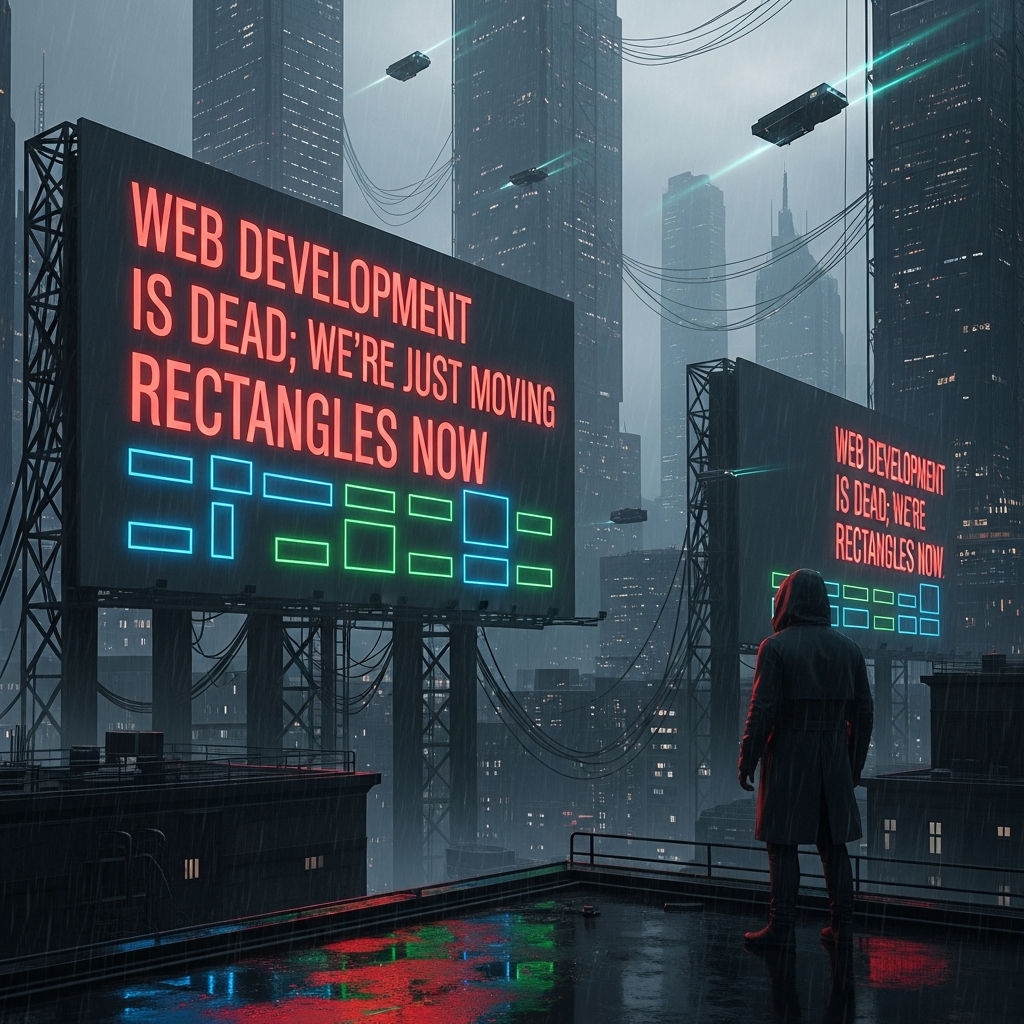
Web Development is Dead; We’re Just Moving Rectangles Now
There was a time when being a web developer felt like being a digital alchemist. You would open a blank text editor, conjure up some semantic HTML, wrestle with floats and clears in CSS, and write “spaghetti” JavaScript to make a button change color. It was chaotic, frustrating, and deeply creative. Every website felt like a unique experiment in a frontier that hadn’t yet been colonized by design systems.
Fast forward to today, and the sentiment among veteran engineers is shifting. A provocative phrase is echoing through Discord servers and tech Twitter: “Web development is dead; we’re just moving rectangles now.” While the industry is technically booming, the “craft” of web development has undergone a fundamental transformation. We have moved from being builders of structures to assemblers of pre-fabricated components.
The Evolution from Craft to Assembly Line
In the early 2010s, building a website required an intimate knowledge of the browser’s quirks. You had to understand the “Box Model” not just in theory, but in the painful reality of Internet Explorer 6. Today, that level of granular struggle is largely gone. Browsers are evergreen, standards are unified, and we have frameworks that abstract away the “webness” of the web.
We are no longer writing code to solve unique layout problems; we are configuring tools to render standardized patterns. The “death” of web development refers to the loss of this low-level creative problem-solving. We have entered the era of the “Assembly Line Developer,” where the primary skill is knowing which library to install rather than how to manipulate the DOM.
The Rectangle Metaphor: Why Component-Driven Development Changed Everything
If you look at a modern web application—whether it’s Spotify, Airbnb, or a niche SaaS tool—it is essentially a collection of nested rectangles. We have headers (rectangles), buttons (small rectangles), cards (rounded rectangles), and sidebars (vertical rectangles). Thanks to the rise of Component-Driven Development (CDD), we treat these shapes as isolated entities.
- Standardization: Design systems like Material UI, Carbon, and Tailwind UI have provided a “Lego kit” for the web.
- Predictability: Businesses prioritize consistency over artistic flair. A rectangle that works on mobile and desktop is better than a custom animation that breaks on Safari.
- Efficiency: Moving a pre-built “Card” component from the left side of the screen to the right is a matter of changing a single prop or a CSS class.
This efficiency is a double-edged sword. While it allows us to build faster than ever, it has reduced the role of the frontend developer to a “layout orchestrator.” We are effectively moving rectangles around a grid until the Product Manager is happy.
Tailwind, shadcn/ui, and the Death of Custom CSS
Nothing illustrates the “moving rectangles” phenomenon better than the meteoric rise of Tailwind CSS and shadcn/ui. In the past, writing CSS was an expressive art form. You would curate a stylesheet, thinking deeply about the cascade and inheritance.
Now, we use utility classes. We apply flex items-center justify-between p-4 rounded-lg and call it a day. Tools like shadcn/ui have taken this a step further by providing the code for the rectangles directly. You don’t even “install” a component library anymore; you just copy the rectangle’s logic into your project. It is incredibly effective, but it reinforces the idea that the “development” part of web development has become a configuration task.
The Rise of the “Product Engineer”
As the technical difficulty of “making things appear on a screen” has plummeted, the industry has rebranded. We are seeing a shift from “Frontend Developers” to “Product Engineers.”
If web development is dead, what replaced it? The answer is product logic. Because we no longer spend three days trying to center a div, we are expected to spend those three days focusing on:
- State Management: Ensuring the data inside the rectangles is synced across the entire application.
- User Experience (UX): Analyzing how users interact with the rectangles to increase conversion rates.
- Integration: Connecting the rectangles to a dozen different APIs, databases, and authentication providers.
In this sense, the “death” of web development is actually an evolution. The complexity hasn’t disappeared; it has simply moved up the stack. We are less concerned with the pixels and more concerned with the purpose.
The Infrastructure Complexity Paradox
While the frontend has become a game of moving rectangles, the “plumbing” of the web has become exponentially more complex. This is the great paradox of modern development. To render a simple rectangle on a screen in 2024, we often employ:
The Modern Tech Stack Overshadowing the Code
- Edge Computing: Deploying rectangles to servers physically close to the user.
- Server-Side Rendering (SSR): Calculating which rectangles to show before the page even loads.
- Hydration: Making static rectangles interactive after they reach the browser.
We have traded the difficulty of CSS for the difficulty of infrastructure. A developer might spend an entire afternoon debugging a Next.js middleware or a Docker container just to change the text inside a blue rectangle. We aren’t just moving rectangles; we are managing the massive global machinery required to transport those rectangles to a user’s phone.
Is AI the Final Nail in the Coffin?
The argument that web development is just “moving rectangles” is being accelerated by Artificial Intelligence. Tools like v0.dev, Anima, and GitHub Copilot are becoming exceptionally good at generating UI. If you ask an AI to “build a dashboard with a sidebar and three stat cards,” it will move the rectangles for you in seconds.
This leads to a frightening question for junior developers: If the job is just moving rectangles, and AI can move rectangles, do I have a job?
The reality is that while AI can assemble the layout, it struggles with the “why.” It doesn’t understand the nuance of a specific business logic or the security implications of how those rectangles talk to a backend. The “death” of traditional coding means that the value of a developer is no longer their ability to write syntax, but their ability to architect systems.
Why We Should Embrace the “Death” of Web Development
It is easy to be cynical about the loss of the “wild west” web, but we must acknowledge what we’ve gained. The “moving rectangles” era has democratized the internet. Small startups can now launch apps that look as professional as Facebook’s because they have access to the same high-quality components.
Web development isn’t “dead” in the sense that it’s gone; it’s dead in the sense that it has matured. We have moved from the “Building Materials” phase of the internet to the “Interior Design” phase. We have the bricks; now we are focused on how people live inside the house.
The Future: Beyond the Rectangle
Eventually, the rectangle metaphor might even fade. As we move toward Spatial Computing (Apple Vision Pro) and Voice UIs, the very concept of a “web page” as a 2D document is being challenged. However, for now, the rectangle remains the king of information hierarchy.
Conclusion: The New Frontier
Web development as we knew it—the era of handcrafted, bespoke code for every minor UI element—is indeed over. We are, for the most part, moving rectangles. But those rectangles represent the global economy, social movements, and human connection.
If you feel like you’re just a “rectangle mover,” it’s time to look at the bigger picture. The challenge is no longer making the box; it’s making the box matter. The “death” of web development is simply the birth of a more powerful, more efficient, and more impact-driven era of software engineering. Stop mourning the pixels and start mastering the product.
“`