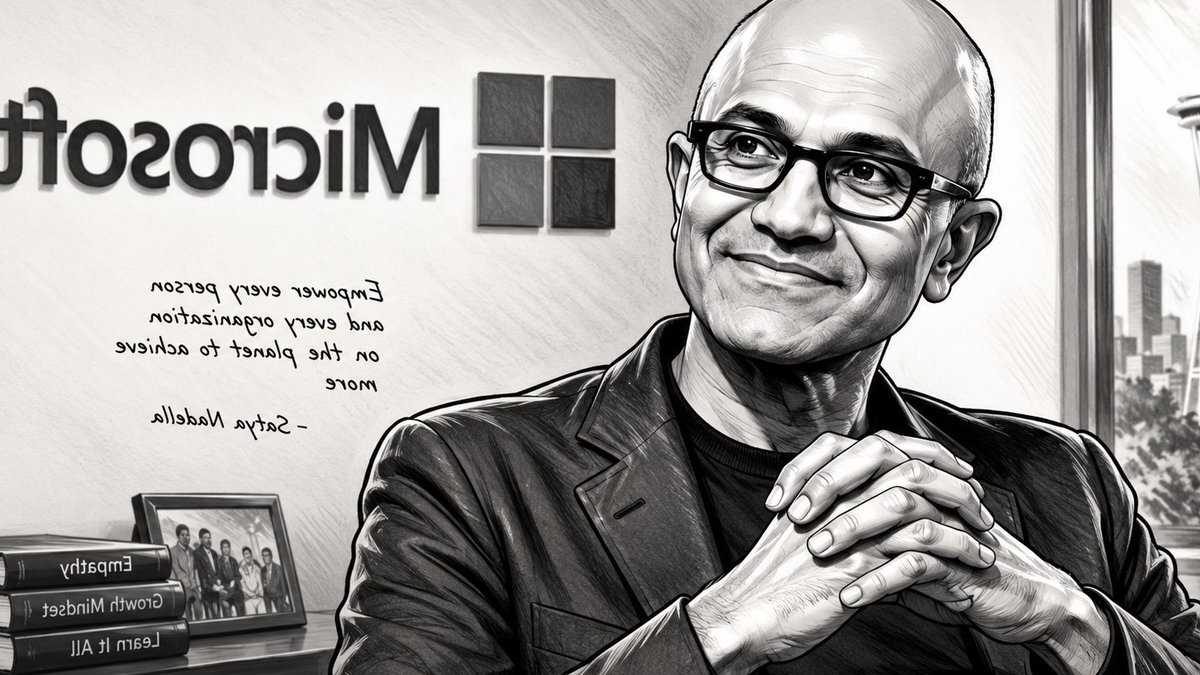
Satya Nadella posted on X early Thursday, warning that the race toward superintelligent systems must be slowed until “human control” is assured. “Any pursuit of superintelligence has to be grounded in the core principle that if the AI we build is not helping humanity and under human control, it’s not worth pursuing,” he wrote.
Calls for a measured pace
The Microsoft chief echoed recent pleas from OpenAI chief Sam Altman and Anthropic co-founder Dario Amodei, who have urged the industry to pause rapid development to avoid catastrophic outcomes. Nadella’s message stressed that research can continue, but only with deliberate pacing and built-in alignment checks.
He added that broader collaboration is needed to turn “talk” into concrete safeguards. The CEO highlighted the importance of “a frontier ecosystem in which both closed and open-source models can thrive,” allowing enterprises to keep proprietary knowledge within their own systems.
Enterprise control and diffusion
Nadella said companies should be able to embed their own data into model weights, creating a “continuous learning loop” that does not lock them to a single provider. He framed this as a way to spread AI benefits across “countries, communities, and companies,” reducing reliance on any one vendor.
In practice, this means firms could run AI workloads on infrastructure they control, rather than depending entirely on external APIs.
For customers, the promise of self-contained learning loops could translate into more predictable costs and fewer surprises when models are updated. It also offers a clearer path to compliance with data-privacy regulations that often restrict cross-border data flows.
Microsoft’s datacenter expansion
Bloomberg reported that Microsoft intends to more than triple its Azure capacity by 2032, boosting power availability from 12 gigawatts to over 38 gigawatts. A single gigawatt can power a city the size of Mumbai or San Francisco, showing the scale of the plan.
The expansion responds to a supply-side crunch that has already forced Microsoft to turn away customers seeking AI-optimized servers. Analysts describe the situation as a Hobson’s choice: either enlarge the Azure footprint or run more of its Copilot AI workloads on existing hardware.
Related Post: Redington partners AvePoint to enhance APAC data resilience
Microsoft’s strategy includes both company-owned sites and leased facilities, suggesting a reluctance to rely on niche cloud providers. Earlier remarks also referenced Chinese open-weight models as part of a broader, diversified AI supply chain.
Currently, roughly 2 GW of the 12 GW capacity handles specialized AI chips, a fraction of total power. By 2032, Microsoft aims for AI hardware to occupy about one-third of the planned 38 GW, indicating a significant shift toward AI-centric compute.
Capacity constraints in the field
Recent incidents highlight the pressure on Microsoft’s infrastructure. E-commerce platform Temu moved to Oracle after Microsoft could not meet its capacity needs, according to Bloomberg. A separate outage at GitHub forced traffic through overseas AWS sites, exposing vulnerability in regional availability.
The company is bringing new sites online, including the “East US 3” cluster near Atlanta. This addition is part of a $145 billion capital-expenditure program announced in the latest fiscal year, aligning Microsoft with rivals Google, Amazon and Meta in a collective effort that could total around $2.4 trillion for global datacenter build-outs.
Nadella argues that a broader AI ecosystem—spanning nations, research fields and academic institutions—will ensure the technology’s benefits are widely shared. He said Microsoft’s approach is to provide “broad access and choice at every layer of the AI stack.”
The rollout will also feature a “Code of Conduct” for first-party models, slated for public consultation. This shift marks a departure from Microsoft’s historic centralized compute model toward a more decentralized, user-controlled framework.
Microsoft has participated in multiple briefings to the U.S. government advocating for wider AI diffusion, including a high-profile open letter coordinated by Nvidia.





Leave a Reply