
“`html
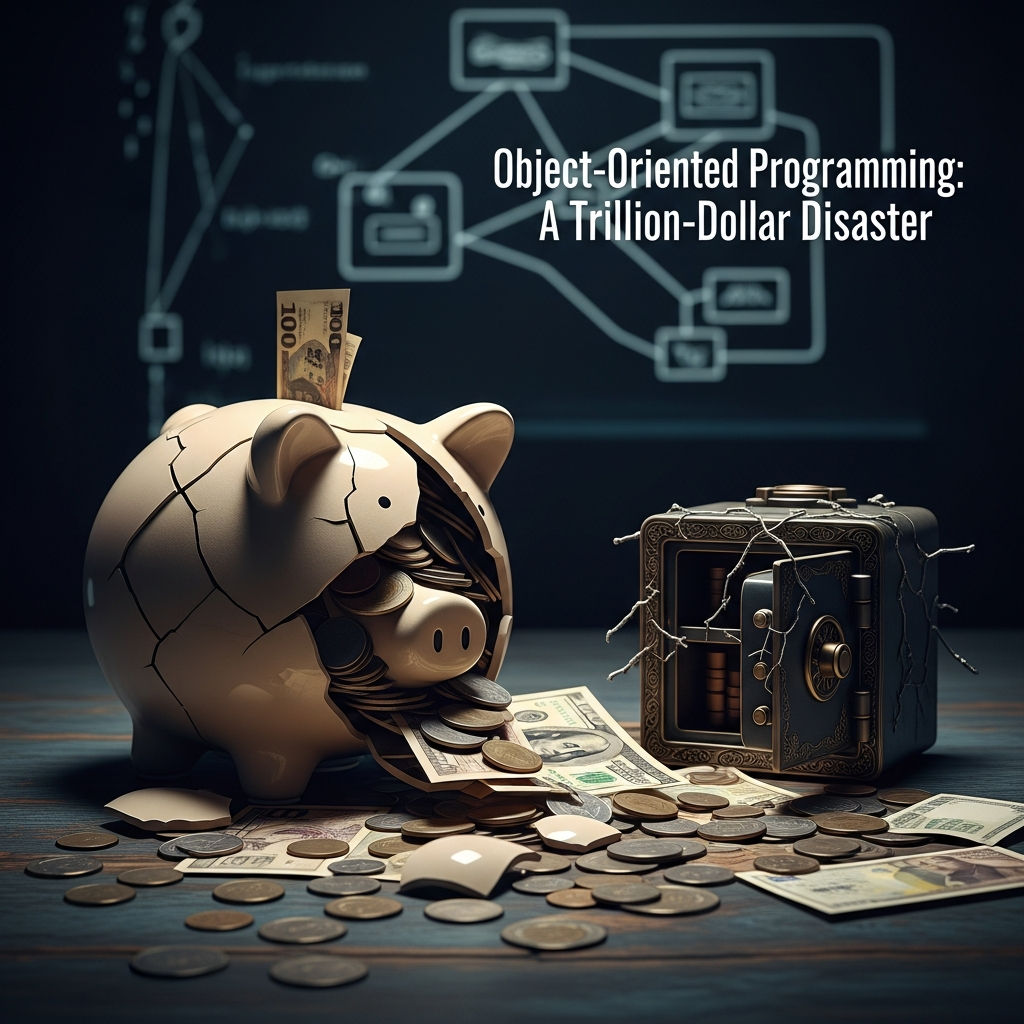
Object-Oriented Programming: A Trillion-Dollar Disaster?
For the last three decades, Object-Oriented Programming (OOP) has been the undisputed king of software development. It is the architectural backbone of Java, C++, C#, and Python. It is taught in almost every university, mandated in corporate environments, and forms the basis of countless enterprise systems. However, a growing chorus of elite developers, computer scientists, and systems architects are calling it something else: a “trillion-dollar disaster.”
The argument is that while OOP promised to make code more reusable, maintainable, and understandable, it has instead delivered a labyrinth of complexity, technical debt, and performance inefficiencies. In this article, we explore why critics believe OOP has failed the software industry and what the alternatives look like.
The Promise vs. The Reality of OOP
The original intent behind OOP was noble. By bundling data and behavior into “objects,” developers hoped to model the real world. The four pillars of OOP—Encapsulation, Inheritance, Polymorphism, and Abstraction—were designed to manage the increasing complexity of software systems. The idea was that you could build a “Car” object, and it would behave like a car regardless of where you plugged it in.
However, the reality of modern enterprise software tells a different story. Instead of clean, modular components, we often find “God Objects,” deep inheritance trees that are impossible to navigate, and state management issues that lead to unpredictable bugs. The “trillion-dollar” figure refers to the cumulative cost of developer hours spent debugging, refactoring, and maintaining these overly complex structures.
The “Banana Monkey Jungle” Problem
One of the most famous critiques of OOP comes from Joe Armstrong, the creator of Erlang. He famously articulated the problem with inheritance and reuse:
“The problem with object-oriented languages is they’ve got all this implicit environment that they carry around with them. You wanted a banana but what you got was a gorilla holding the banana and the entire jungle.”
In OOP, if you want to reuse a specific class, you often have to pull in its parent class, and the parent’s parent, and all the associated dependencies. This leads to several issues:
- Tight Coupling: Components become so intertwined that changing one part of the system breaks five unrelated parts.
- Fragile Base Classes: A minor change in a base class can have catastrophic ripple effects down the inheritance chain.
- Bloated Codebases: Developers often include massive libraries just to use a fraction of their functionality, leading to “software rot.”
The Curse of Mutable State
At the heart of the “OOP disaster” is the concept of Mutable State. In OOP, objects encapsulate data and then provide methods to change that data. While this sounds intuitive, it is a nightmare for modern computing, particularly regarding concurrency and parallelism.
When multiple parts of a program share a reference to the same object and can modify its state at any time, you invite “race conditions.” Tracking down which thread changed a variable at what time becomes an exercise in futility. Critics argue that by encouraging hidden, mutable states, OOP makes software inherently non-deterministic and prone to bugs that are nearly impossible to replicate in testing environments.
Encapsulation: An Illusion of Safety
Encapsulation is supposed to hide complexity. However, in large-scale systems, it often just hides the cause of bugs. Because an object’s internal state can be changed by its own methods, and those methods might be called by any number of external actors, the “capsule” becomes a black box where logic goes to die. You no longer have a clear flow of data; you have a web of objects whispering to each other behind the scenes.
The Performance Tax
Beyond the developer experience, there is a physical cost to OOP: hardware efficiency. Modern CPUs are designed to process data in contiguous blocks (Data-Oriented Design). They love arrays and predictable memory patterns. This allows for “cache hits,” where the CPU can rapidly access the next piece of data it needs.

OOP, by its very nature, tends to scatter data across RAM. Every time you create a new object, it might be stored in a different memory location. When your code iterates through a list of objects to perform a calculation, the CPU is constantly waiting for “pointers” to resolve. This “pointer chasing” results in massive cache misses, meaning modern software often runs at a fraction of the speed the hardware is actually capable of.
Why is OOP Still Dominant?
If OOP is such a “disaster,” why do we keep using it? There are several systemic reasons:
- The Education Loop: Universities have taught OOP for decades. New professors were taught OOP by their professors, creating a self-perpetuating cycle.
- Corporate Standardization: Large corporations value “fungible” developers. It is easier to hire 100 Java developers who understand standard OOP patterns than to find specialists in more niche, efficient paradigms.
- Tooling and Ecosystems: The infrastructure for OOP (IDEs, debuggers, libraries) is incredibly mature. Switching away from it requires a massive investment in new tooling.
The Rise of Alternatives: Functional and Data-Oriented
The industry is beginning to pivot. We are seeing a “Renaissance” in alternative paradigms that address the flaws of Object-Oriented Programming.
1. Functional Programming (FP)
Languages like Elixir, Haskell, and even features in modern JavaScript and Rust emphasize Immutability and Pure Functions. In FP, data and logic are separate. Instead of changing a “User” object, you take the old data and return a new, updated version. This eliminates entire categories of bugs related to state and makes concurrent programming significantly easier.
2. Data-Oriented Design (DOD)
Prevalent in high-performance game development (like the Unity DOTS framework), Data-Oriented Design focuses on how data is laid out in memory. By moving away from “objects” and toward “systems” and “components,” DOD allows programs to utilize the full power of modern CPU architectures, often achieving 10x to 100x performance gains over traditional OOP approaches.
3. Composition Over Inheritance
Even within the OOP world, the mantra “favor composition over inheritance” has become a survival guide. Instead of building deep hierarchies (A is a B), developers are building flat structures (A has a B). This reduces the “Banana Monkey Jungle” effect and makes code more modular.
Conclusion: Is It Really a Disaster?
To call OOP a “trillion-dollar disaster” might be hyperbolic, but it highlights a painful truth: the software industry has spent billions of dollars fighting the very tools it chose to embrace. OOP was a solution for a different era—an era where software was smaller and concurrency was a niche concern.
As we move into an age of massive distributed systems and multi-core dominance, the cracks in the OOP foundation are becoming impossible to ignore. Whether OOP will be replaced entirely or simply relegated to a secondary role remains to be seen. However, for the modern developer, understanding the limitations of objects is no longer optional—it is a requirement for building the high-performance, reliable systems of the future.
Summary Key Takeaways:
- OOP often leads to unnecessary complexity through deep inheritance.
- Mutable state in OOP makes thread-safety and concurrency difficult.
- The memory layout of objects can significantly degrade CPU performance.
- Functional Programming and Data-Oriented Design offer modern solutions to these legacy problems.
“`