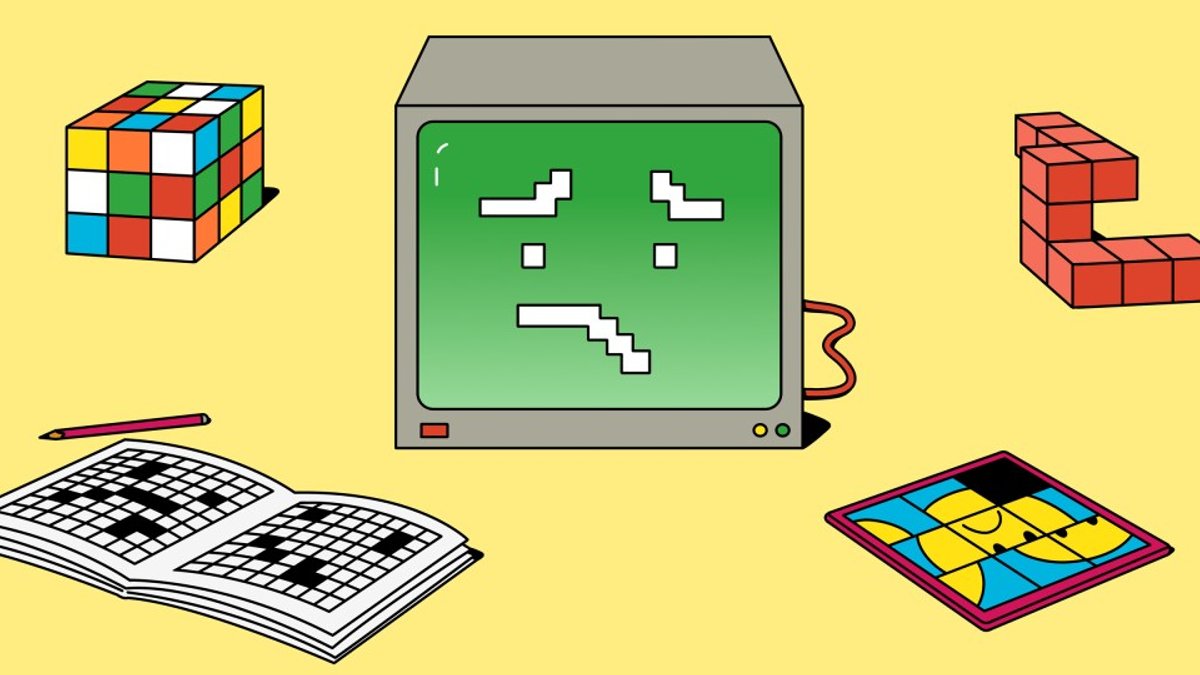
AI models often stumble when tested on classic intelligence puzzles. While these systems have advanced rapidly in natural language processing, they still struggle to replicate human problem-solving across various domains. Researchers at MIT Technology Review and Columbia University have observed that even the most capable systems fail to solve specific riddles and visual challenges, often missing the subtle cues that humans catch instantly.
One major weakness involves spatial reasoning. Models can analyze images, but they struggle with tasks like mental rotation puzzles. These problems require visualizing objects from different angles, a skill that humans typically perform well. AI systems, including advanced language models, often fail at these 3D manipulation tasks despite their ability to process visual inputs.
They struggle with mental rotation puzzles because they cannot visualize objects from different angles. This skill is something that humans typically perform well. The researchers note that AI systems, including advanced language models, often fail at these tasks.
Another area of difficulty involves memory and adaptability. LLMs process vast amounts of text during training, which helps them recall facts. However, this can backfire. If a puzzle closely resembles a problem the model saw during training, it might memorize the answer rather than solving the new instance.
This phenomenon was evident in a 2024 study using variations of Knights and Knaves puzzles, where models failed to distinguish between similar but distinct problems. The study highlights the limitations of current AI models in adapting to new situations.
Visual puzzles in two dimensions also trip up AI. The ARC-AGI benchmark, a famous test for abstract reasoning, reveals that models often rely on complex, non-generalizable rules to solve problems. While they have improved recently, they still lag behind humans who use simple visual concepts to infer the correct answer.
Sometimes, even a simple change in the rules can cause a top-tier model to fail completely. This lack of flexibility is a major limitation of current AI systems.
Despite these failures, AI still outperforms humans in some areas. Studies show that models can solve simple versions of logic puzzles like the Tower of Hanoi and river-crossing problems.
However, as the complexity increases—such as adding more disks or people—the models begin to falter. This suggests that while AI is good at handling straightforward scenarios, it struggles with scaling logic.
Human intuition often leads to errors, while AI tends to be more deliberative. Psychologists have designed tests that exploit human cognitive biases, such as the tendency to overthink simple questions.
In these cases, humans give knee-jerk answers, whereas AI responds with a more calculated approach. This difference highlights a fundamental distinction between human and machine cognition, and the need for operational systems that can handle complex scenarios.
As AI models continue to evolve, their performance on these puzzles will likely improve. Current systems can already solve many challenges that stumped them a year ago, but they still have a long way to go to match human versatility.
For now, the gap between machine and human reasoning remains wide, particularly in tasks requiring deep spatial understanding and flexible problem-solving. The researchers at MIT Technology Review and Columbia University will continue to study this gap and develop new AI models that can bridge it.



Leave a Reply