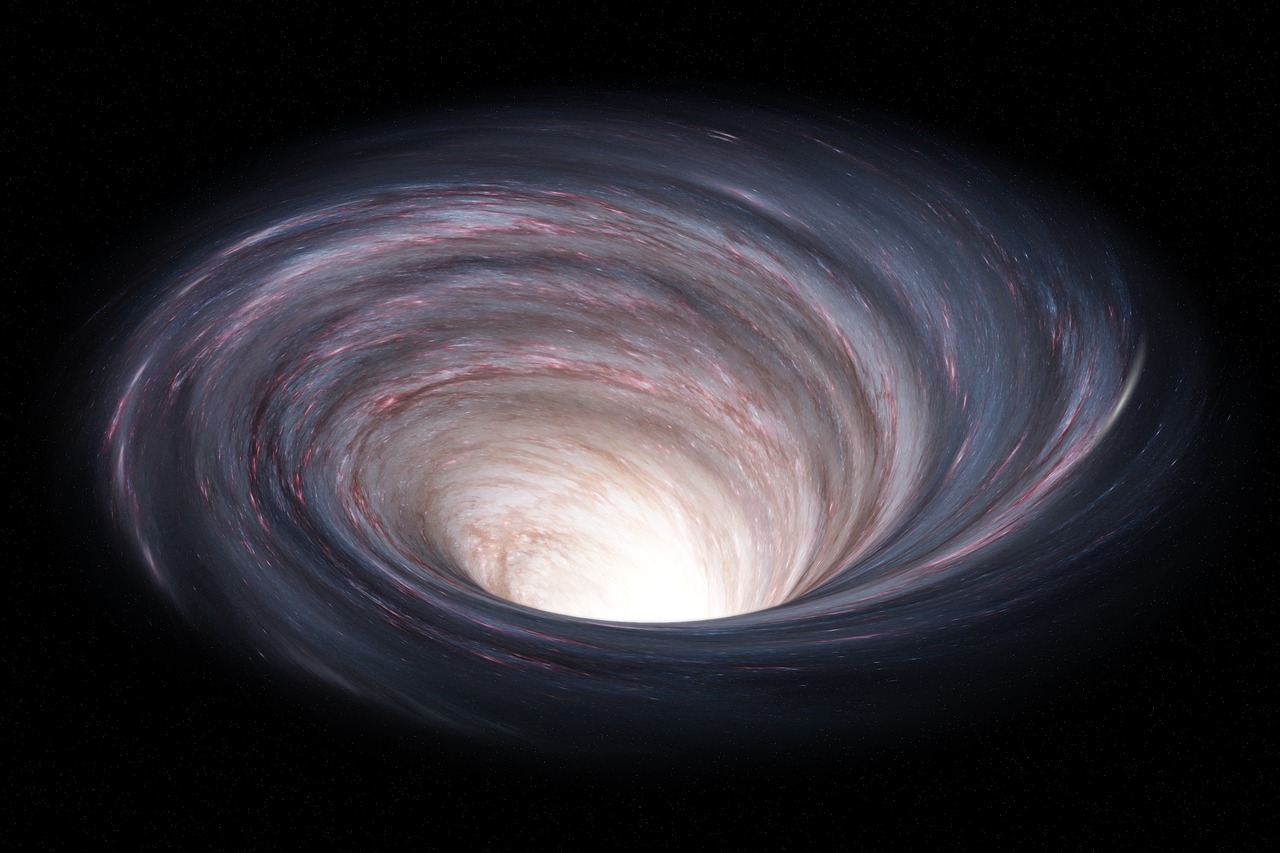
Astronomers have detected a black hole collision in unprecedented detail, confirming decades-old predictions by Albert Einstein and Stephen Hawking. The event, called GW250114, was spotted in January by the Laser Interferometer Gravitational-Wave Observatory (LIGO), a pair of instruments in Louisiana and Washington. These detectors picked up gravitational waves — faint ripples in space-time — produced when two black holes slammed together.
They were each about 30 to 35 times the mass of the sun and spinning slowly, said Maximiliano Isi, an assistant professor at Columbia University and astrophysicist at the Flatiron Institute’s Center for Computational Astrophysics. Isi led a new study for the LIGO-Virgo-KAGRA Collaboration, published Wednesday in the journal Physical Review Letters.
“The black holes were about 1 billion light years away, and they were orbiting around each other in almost a perfect circle,” he said. “The resulting black hole was around 63 times the mass of the sun, and it was spinning at 100 revolutions per second.”
That makes the merger an almost exact replica of LIGO’s first detection from 2015, but with much greater clarity thanks to instrument upgrades. “We can see these two black holes with much greater clarity, as they approached each other and merged into a single one,” he added.
Related: Futureproof your career in an AI world
The observatory works by detecting tiny stretches in space caused by gravitational waves — changes in distance “1,000 times smaller than the radius of the nucleus of an atom,” Isi said. Since its debut, the observatory’s lasers and mirrors have been upgraded to reduce noise and improve accuracy. The new observation is over three times more precise than the one a decade ago.
That clarity allowed researchers to test two key predictions. The first, from mathematician Roy Kerr in 1963, builds on Einstein’s general relativity and says they should be described by just two numbers: mass and rotation. “Everything there is to know about them should come from how big the black hole is and how fast it’s rotating,” he said.
To test this, scientists looked at the “ringing” of the final black hole — a vibration like a bell struck by a hammer. “The pitch and duration of the sound tell you something about what the bell is made of. With black holes something similar happens — they ring in gravitational waves,” he said. GW250114 returned a signal with two distinct modes: a fundamental tone and an overtone, far clearer than any previous observation.
“We identified two components of this ringing, and that allowed us to test that this black hole really is consistent with being described by just two numbers, mass and rotation,” Isi said. “It’s the first time we are able to see this so compellingly,” he said.
“It’s a profound, but very simple theorem that says the total surface area of a black hole can never decrease — it can only get bigger or stay the same,” he said.
Related: Google Teams Up with Tech Rivals
Previous observations by the observatory offered tentative confirmations, but the new signal gives researchers far more confidence. “Because we’re able to identify the portion of the signal that comes from the black holes early on, as they are separated from each other, we can infer their areas from that,” Isi explained. “Then we can look at the very final portion of the signal that comes from the final black hole, and measure its own area.”
Kip Thorne, a Nobel laureate for observatory contributions, said Hawking called him right after the 2015 detection to ask if the observatory could test his theorem. “If Hawking were alive, he would have reveled in seeing the area of the merged black holes increase,” Thorne said in a statement.
He noted that confirming Hawking’s equation could help in the long-sought goal of combining general relativity with quantum mechanics. “Einstein’s theories are like the operating system for all of this,” he said.
Emanuele Berti, a physics professor at Johns Hopkins University not involved in the study, described the detectors as “hearing aids” for such waves. “A large group of scientists spent the last ten years improving those hearing aids, and now we can ‘hear’ the signals with much higher clarity,” he said in an email. “We can now test fundamental principles of gravity that we could not test ten years ago.”
Related: How To Keep Yourself Safe Online in 2023
Leor Barack, a professor at the University of Southampton who also was not part of the study, called the event “particularly spectacular” and said scientists extracted two “pure tones” of the remnant black hole — including the first clear extraction of an overtone. “This kind of test is the most precise to date, by a long margin,” he said.
Macarena Lagos, an assistant professor at the Universidad Andrés Bello in Chile, said the detection of a second tone is especially significant. “While current tests of gravity still have broad uncertainties, this work lays the groundwork for future detections” of even better quality, she said in an email.
The study appears as the observatory, along with its sister instruments Virgo in Italy and KAGRA in Japan, continues to observe the universe through such waves. Since 2015, scientists have recorded over 300 such mergers. Earlier this year, it detected the most massive collision to date, between objects roughly 100 and 140 times the sun’s mass.
Such waves, first predicted by Einstein in 1915 as part of his theory of general relativity, were long thought too weak to detect. The observatory proved otherwise in 2015, earning a Nobel Prize for key contributors. The latest results, the astrophysicist said, show how “LIGO has created an entire new branch of astronomy.”





Leave a Reply