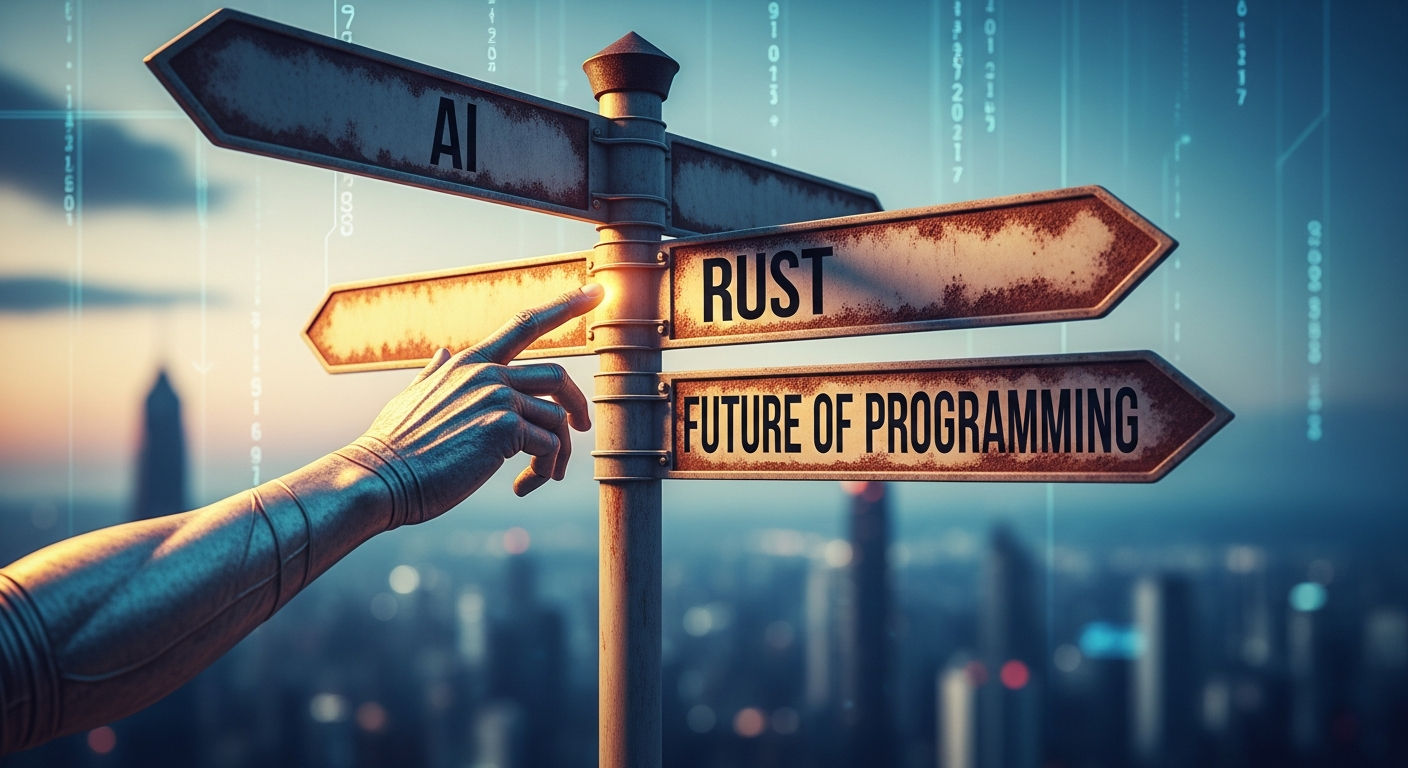
The Architecture of Change: Navigating the Convergence of AI and Rust in Modern Programming
I spent three hours yesterday staring at a stack trace that shouldn’t have existed. For anyone who has spent the better part of a decade wrestling with memory leaks in C++ or the “black box” unpredictability of Python’s garbage collector, that feeling is visceral. It’s a mix of exhaustion and the nagging suspicion that our tools are failing us. But then, I ran my code through a Rust compiler. It screamed at me. It pointed out a lifetime issue I had completely overlooked, and within five minutes, the logic was sound. This isn’t just about a new language; it’s about a fundamental shift in how we think about code, especially now that Artificial Intelligence is sitting in the passenger seat.
The industry is currently caught in a pincer movement. On one side, we have the explosive growth of AI, which promises to automate the mundane and generate boilerplate at the speed of thought. On the other, we have Rust, a language that demands a level of precision and strictness that feels almost antithetical to the “move fast and break things” ethos of the last decade. Navigating this paradigm shift requires us to stop looking at these as separate trends and start seeing them as the twin pillars of the next era of software engineering. We are moving away from the era of “Guess and Check” and into the era of “Design and Verify.”
The End of the “Good Enough” Era
For years, we traded performance and safety for developer velocity. If a program was slow, we threw more RAM at it. If it crashed, we wrote another unit test. This “good enough” philosophy fueled the web revolution, but we’ve hit a wall. Modern systems—especially those running intensive AI workloads or low-latency edge computing—can no longer afford the overhead of traditional managed languages. I’ve seen production environments buckle under the weight of Python’s Global Interpreter Lock (GIL) when trying to scale real-time data processing. It’s messy, it’s expensive, and frankly, it’s unnecessary.
Rust entered the scene not as a hobbyist’s toy, but as a necessary correction. Its core value proposition—memory safety without a garbage collector—is the holy grail of systems programming. By moving the “check” from runtime to compile-time, Rust forces you to handle the edge cases before your users ever see them. It is a rigid, often stubborn language. The borrow checker is a harsh mentor. But once you align your mental model with Rust’s ownership system, you realize that the language isn’t trying to slow you down; it’s trying to keep you from building a house of cards.
AI as the Great Equalizer (and the Great Noisy Neighbor)
Then there’s the AI elephant in the room. Large Language Models (LLMs) like GPT-4 and Claude have changed my daily workflow more than any IDE update ever has. I use AI to brainstorm architectural patterns, generate repetitive boilerplate, and explain obscure crate documentation. However, there is a dangerous trap here. AI is exceptionally good at producing code that looks correct but is subtly, catastrophically broken. If you ask an AI to write a complex asynchronous function in a loose language, it might give you something that runs 90% of the time but fails under race conditions.
This is where the synergy with Rust becomes magical. Rust’s compiler acts as the ultimate filter for AI-generated code. When I ask an LLM to “write a thread-safe cache in Rust,” the compiler won’t let the AI lie to me. If the generated code tries to violate memory safety or creates a potential data race, the compiler rejects it. This creates a feedback loop where the human provides the intent, the AI provides the draft, and the Rust compiler provides the truth. We are seeing a shift where the developer’s role is no longer just “writing code” but “verifying logic.”
Why High-Performance AI Infrastructure is Moving to Rust
If you look under the hood of the most exciting AI developments today, you’ll see Rust’s fingerprints everywhere. While Python remains the undisputed king of the “interface” for data science—largely due to its low barrier to entry—the heavy lifting is moving. Projects like Hugging Face’s Candle or the Burn framework are proving that we don’t need the bloated dependencies of traditional frameworks to run high-performance models. We need the lean, predictable performance that only systems languages can provide.
I recently worked on a project where we ported a data ingestion pipeline from a traditional interpreted setup to a Rust-based microservice. The results weren’t just “faster.” We saw a 10x reduction in memory footprint and a level of stability that allowed us to sleep through the night without worrying about OOM (Out of Memory) kills. When you are deploying models that cost thousands of dollars to train, you want the deployment engine to be as robust as possible. Rust provides that certainty. It turns “I think this will scale” into “I know this will scale.”
The Skillset Shift: From Syntax Monkey to System Architect
The fear that AI will replace programmers is, in my opinion, a misunderstanding of what we actually do. If your job is just translating requirements into basic CRUD (Create, Read, Update, Delete) apps, then yes, your days might be numbered. But if your job is solving complex problems, the paradigm shift is actually an upgrade. The combination of AI and Rust elevates the developer to a System Architect. We are now tasked with managing higher levels of abstraction while the tools handle the low-level minutiae.
This requires a different kind of learning. Instead of memorizing syntax, we need to understand memory layouts, concurrency models, and how to prompt an AI to think through a problem rather than just spit out an answer. I often tell my colleagues that learning Rust made me a better programmer in every other language. It forced me to think about where my data lives and who “owns” it. When you combine that disciplined thinking with the raw generative power of AI, you become a force multiplier. You can build systems that are both more complex and more reliable than what was possible five years ago.
However, we must be wary of the “copy-paste” temptation. The ease of AI can lead to architectural laziness. I’ve seen teams generate massive amounts of Rust code without understanding the underlying ownership model, leading to a “refactoring debt” that is much harder to pay off than standard technical debt. The tool is only as good as the hand that wields it. You still need to understand why a Mutex is necessary or how an Arc works, even if the AI wrote the implementation for you.
A Future Built on Determinism
The future of programming is leaning toward determinism. In a world increasingly dominated by the probabilistic nature of AI, we need our core infrastructure to be more deterministic than ever. We cannot have “maybe” when it comes to the safety of our autonomous vehicles, our financial systems, or our healthcare data. Rust provides the deterministic foundation, while AI provides the creative spark to accelerate development.
We are moving toward a world where the “compiler as a partner” is the norm. Imagine an environment where the AI suggests a performance optimization, the Rust compiler verifies its safety, and the developer validates the business logic. This isn’t a distant dream; it’s happening in the repositories of top-tier tech companies right now. The barrier to entry for high-performance programming is dropping, but the ceiling for what we can create is exploding.
If you’re a developer today, my advice is simple: lean into the friction. Don’t shy away from Rust because it’s “hard.” The hardness is the point. It’s the friction that polishes the diamond. At the same time, embrace AI as a tireless pair-programmer, but treat it like a brilliant intern who needs constant supervision. The developers who thrive in this new paradigm won’t be the ones who can code the fastest, but the ones who can design the most resilient systems using the most powerful tools available. The era of guessing is over. The era of precision has begun.





Leave a Reply