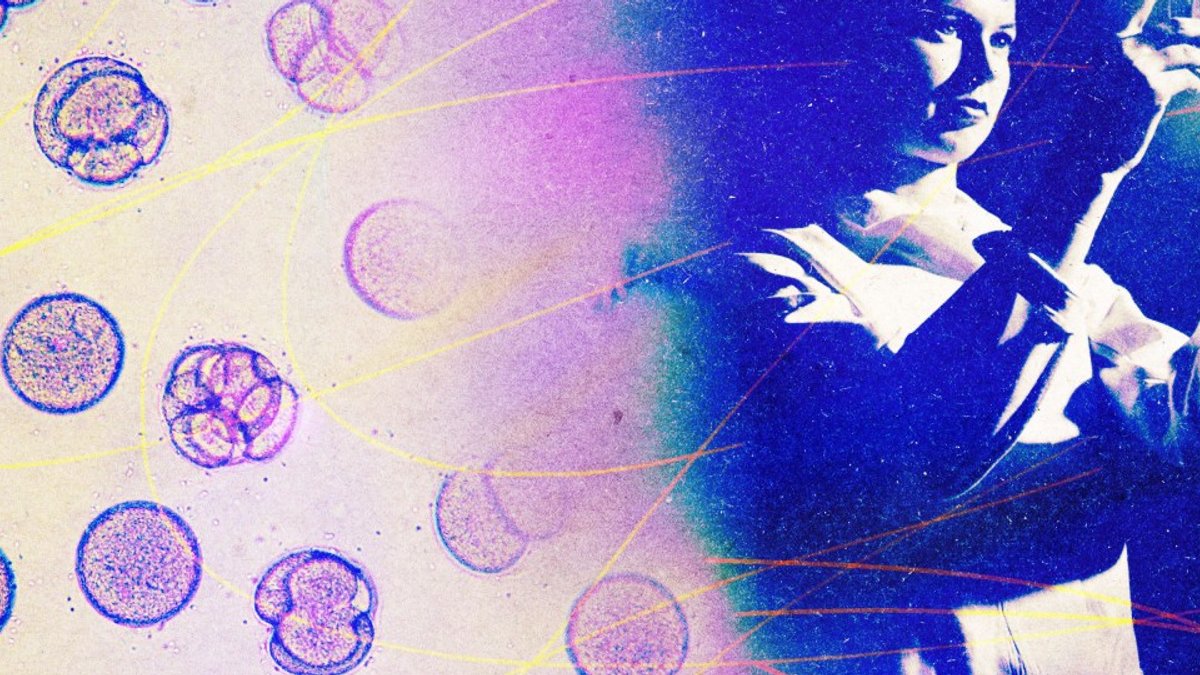
When the biotech company Insilico Medicine used its computer models to propose a promising drug for pulmonary fibrosis, it claimed in a press release that the molecule had been “discovered by” its generative AI platform. However, when it came time to file for a patent to protect that new chemical structure, the company made no mention of AI.
The patent names five humans, including CEO Alex Zhavoronkov, as the drug’s “inventors.” This discrepancy points to a fascinating wrinkle in intellectual-property law, where no matter how fundamental an AI is to a discovery, humans can take the credit.
US courts reached that conclusion after Ryan Abbott, a partner at the LA law firm Brown, Neri, Smith & Khan, brought a pro bono test case naming an AI called DABUS as an inventor of a better food container. The case might have raised philosophical questions, but in 2022, an appeals court in Washington, DC, said these “metaphysical matters” were beside the point.
Instead, it noted that US statutes describe an inventor as an “individual,” the plain meaning of which is a human being. Since machines aren’t people, they can’t be inventors.
“There needs to be a human inventor or there’s no invention and no patent,” says Sarah Korman, a patent attorney who is now chief business officer and legal officer of Isomorphic Labs, an Alphabet spinout with big ambitions for AI cures. Korman added that there is “no doubt” our laws will need to evolve to keep pace with AI.
AIs can invent things, and in the future, they may do so with less and less human intervention. The US Patent and Trademark Office has acknowledged that “an AI system—like other tools—may perform acts that, if performed by a human, could constitute inventorship under our laws.”
As Abbott believes, there could be legal challenges to AI-generated drugs, since one way to invalidate a patent is to show it has the wrong inventors listed. This could put a damper on future drug development, especially since the US Copyright Office is refusing to grant copyrights to images and text generated by AI.
The point of our intellectual-property laws is to encourage innovation, Abbott says. It’s right there in Article 1 of the US Constitution, which says inventors and authors need to be given exclusive rights to their ideas, for a limited time, in order “to promote the Progress of Science and the Useful Arts.”
Currently, the US patent office seems to be taking a don’t-ask-don’t-tell approach to the use of AI. Under the Biden administration, the agency published guidance to help applicants determine whether and when humans would truly qualify as co-inventors of an AI discovery.
At Insilico, Zhavoronkov says, human chemists still have to synthesize the drugs, create variants, and test them on animals. “That’s the person who is going to be named on the patent,” he says. “And even if you decided to completely roboticize this process, including the experiments, someone will still push the button and give the budget.”
Abbott says that’s a matter for future legal cases. “What if I asked Claude to cure cancer, and it did?” he says. “I think it would be inappropriate to claim that I invented that.” The issue of AI-generated inventions is complex, and as AI technology advances, it will be interesting to see how the law adapts to address these challenges, potentially drawing on existing research and AI chip design.



Leave a Reply